
Short answer
Searching for documents takes time, but a folder's appearance cannot tell you how much that time costs or how much a naming tool could recover. Measure a sample of your team's work, then use a clearly labeled scenario to explore the possibilities.
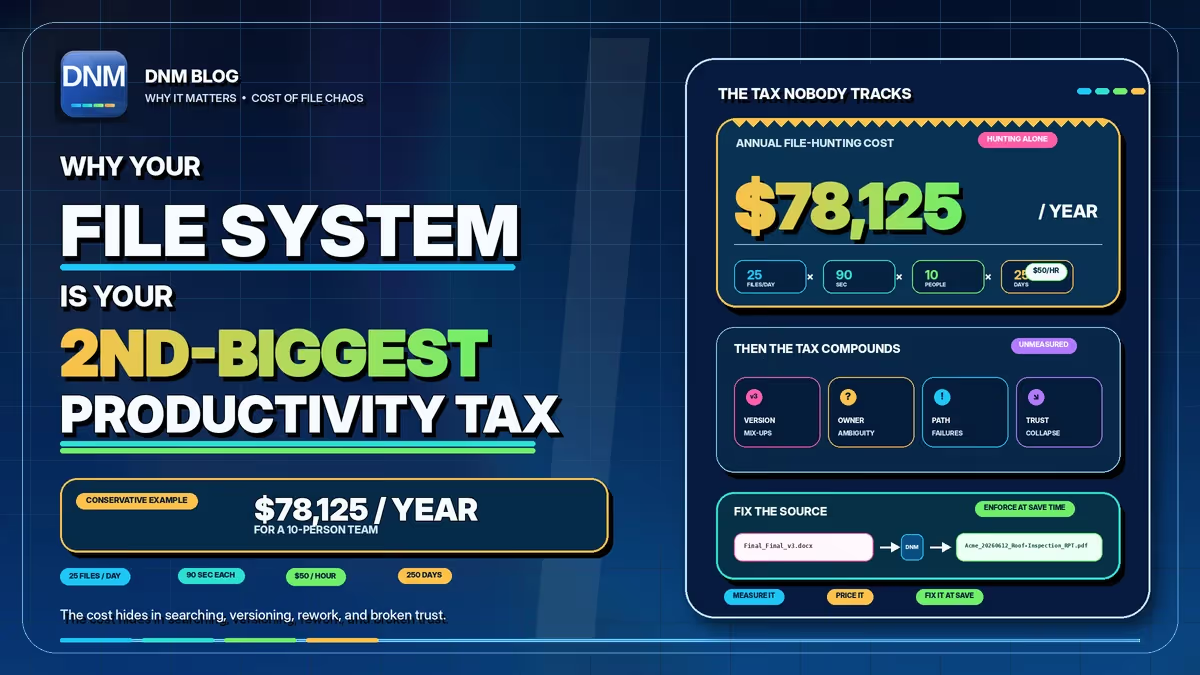
The Cost of File Chaos calculator models your inputs. It does not scan a drive, measure lost productivity or predict DNM's performance. The worked example below illustrates the calculation, not an observed customer result.
What should you measure?
Record how often people search, how long those searches take and what causes the difficult ones. Separate necessary retrieval from avoidable confusion. Missing permissions, an incomplete index and uncertainty over approval may need different fixes from unclear filenames.
Sample ordinary work rather than only the worst incidents. Choose a labor-rate assumption that makes sense for the planning question, and keep the original observations so you can compare the workflow later.
How much does file chaos actually cost? A worked example
For illustration, assume a ten-person team, 25 searches per person each day, 90 seconds per search, a loaded labor rate of $50 an hour and 250 work days. These are scenario inputs, not measured averages or a claim that the estimate is conservative.
(25 x 90 x 10 x 250) / 3600 = 1,562.5 search hours per year. At USD $50 an hour, that time has a modeled labor value of USD $78,125.
That total includes necessary searches. It does not show how much time DNM would save, and time released is not necessarily a cash saving. Use your own search measurements and an assumed reduction in the calculator; the result changes with those inputs. All monetary figures in this example are in USD.
What a 40% assumption changes
The calculator starts with an assumed 40% reduction in search time. This is an illustrative input, not a typical, expected or measured DNM result. With the inputs above:
- 625 potential hours released per year: 1,562.5 hours multiplied by 40%.
- USD $31,250 in potential annual labor value: 625 hours multiplied by USD $50.
- USD $1,200 in modeled annual license fees: 10 licenses at USD $10 per month for 12 months, before tax.
- USD $30,050 in labor value less license fees: before setup, training, ongoing review and other costs. This is not cash savings or profit.
You can set the assumed reduction anywhere from 0% to 100%. At 0%, this example releases no time and the value less license fees is negative USD $1,200. At 100%, the model reaches a theoretical limit, not a promise that all searches can be eliminated.
One license per person is a cost assumption, not a rule about users or device activations. Other plans and regional checkout prices differ; check current pricing for your purchase.
Naming is only one part of retrieval
- Revision ambiguity: a filename can record a revision label, but it does not prove which version was approved.
- Missing context: a client reference and specific description can make a file easier to recognize, but the values must be correct.
- Path problems: a shorter name can help, but check the complete destination path and the applications that use it.
Test a practical change
Agree on a naming pattern and explain its field meanings. Use a representative set of incoming files, review the suggested names and record the effort needed to prepare and check them. Keep the written guidance and periodic review; a tool is one part of the process.
DNM provides saved fields and local suggestions for files you import or queue through Watch Folder. Users check and save them. It does not intercept every Windows Save dialog or centrally enforce a team policy.
A reviewed Strata name might be STRATA1234_20260424_INV_ABC-Plumbing-Leak-Repair.pdf. Name sorting groups by the Division, then date, then the remaining fields. A type after the date does not group all invoices across every date.
DNM's common Windows and Microsoft 365 checks can flag naming issues, but they do not validate a document's business meaning or guarantee migration success. Naming and supported OCR run locally without document uploads to a naming service.
Make the budget decision from your own evidence
Compare measured search and naming effort before and after a trial. Include setup, training, ongoing review and any other costs separately. Released time is useful only if it can be used productively; it is not automatically money removed from payroll.
Explore a pattern in the generator, read the standard or try DNM free for 14 days. Use the calculator to vary assumptions, not to substitute for that test.
Common questions
Is the calculator's 40% reduction a measured DNM result?
No. It is an illustrative starting assumption. You can set the assumed reduction anywhere from 0% to 100%.
Is labor value less license fees the same as cash savings?
No. It values potentially released time and subtracts modeled license fees. Setup, training, ongoing review and other costs are excluded.
What happens at a 0% assumed reduction?
The model releases no time. In the ten-license worked example, labor value less annual license fees is negative USD $1,200.